 صوت راديو الحياة
Archeology
The Ashdod Beaches Department Deputy Director, who usually helps bathers locate their lost jewelry and objects discovered this time himself a very rare 2,500-year-old coin, originating from Cyprus. After he handed it over to the IAA, it turned out: This is the first coin of its kind ever discovered in The Holy Land.
A rare coin, originating in Cyprus and approximately 2,500 years old, was recently discovered at one of Ashdod Beaches. Avi Chaprak, Deputy Director of the Ashdod Beaches Department, usually helps residents and visitors locate jewelry, keys, and objects they lost on the beach. About a month ago, during a search to locate lost objects, he noticed a completely different item: an ancient coin.
Chaprak, acting in accordance with the antiquities law, submitted the coin to the IAA. After an examination by the IAA Coin Department, it turned out that this was an extraordinary discovery: an exceptionally rare coin, the first of its kind discovered to date in The Holy Land.
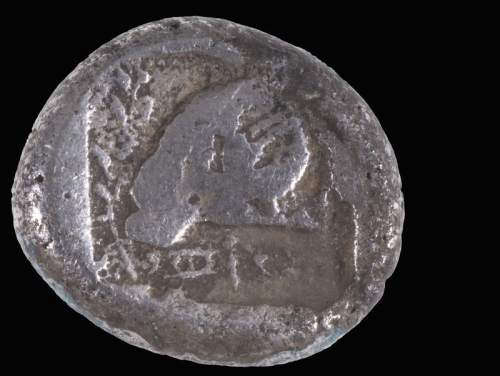
The coin was minted in the ancient city of Salamis located on the east coast of Cyprus, around the mid-5th century BCE when the Persian empire held sway over the island. Weighing about 11 grams, it is a standard coin known as a “Siglos. “At first glance it looked to be made of silver, but a closer examination showed it to actually be of metal that was only plated with silver; a known phenomenon in Cypriot silver coins from this period, given the shortage of silver on the island,” says Yanniv David Levy, Researcher and Curator in the IAA Coin Department.
One side of the coin depicts a left-facing recumbent ram. The other side features a left-facing ram’s head set within an incuse (sunken) square frame. Next to it is a laurel branch, placed vertically, with three symbols below it, apparently of the Cypriot syllabic script.
“Coins of this size and value from the Persian period are rare altogether in the archaeological record,” he adds. “Usually, silver coins of this size were not preserved intact. Over time, they were cut into small pieces, for use as local trade currency. Furthermore, evidence of such use is known mainly from inland sites in the Holy Land. Therefore, the discovery of a complete coin from the coastal area, is thus unusual on all accounts, and of special historical importance.”
Writing from Athens, Dr. Evangeline Markou, Senior Researcher at the Institute of Historical Research, National Hellenic Research Foundation, and an expert in ancient Cypriot coinage, explains: “Salamis coins from the 5th century BCE were circulating throughout the eastern Mediterranean. However, finds with an exact provenance are rarer, and therefore this coin potentially offers significant information about trade ties and movement between Cyprus and the Holy Land during this period.”
Levy representing the Holy Land archaeological perspective fully agrees: “The circumstances of the discovery and the accurate reporting allow us researchers, not only to identify the coin itself, but also to use it as a reliable source of information about economic and maritime ties that existed in this region some 2,500 years ago.”
Chaprak was awarded a certificate of appreciation for reporting the coin and handing it over to the IAA Coin Department. “I am happy that I was privileged to be part of a discovery of historical value,” Avi says. “For me, it was clear that the coin belonged to our collective heritage, so I immediately delivered it to the IAA. If through this act I contributed another small piece towards the research and history of the Holy Land, then that is a great honor for me.”
Minister of Heritage Rabbi Amihai Eliyahu said, “The rare coin discovered on the Ashdod coast is tangible evidence of the maritime and commercial ties that existed between the Holy Land and Cyprus some 2,500 years ago. I commend Avi Chaprak, who acted responsibly and transferred the coin to the IAA. The public’s cooperation in reporting on antiquities makes it possible to preserve the heritage assets that belong to all of us, to deepen knowledge about the country's past, and to ensure that the finds will be preserved and studied for the benefit of future generations.”
The rare 2500-year-old coin. Photo: Shai Halevi, IAA.
 A 1,300-year-old complex was discovered near Winter Stadium
 Rare Mold for Producing Figurines Discovered at the Tower of David Jerusalem Museum Excavations
 Burnt Wooden Beams from the Destruction of Jerusalem.